
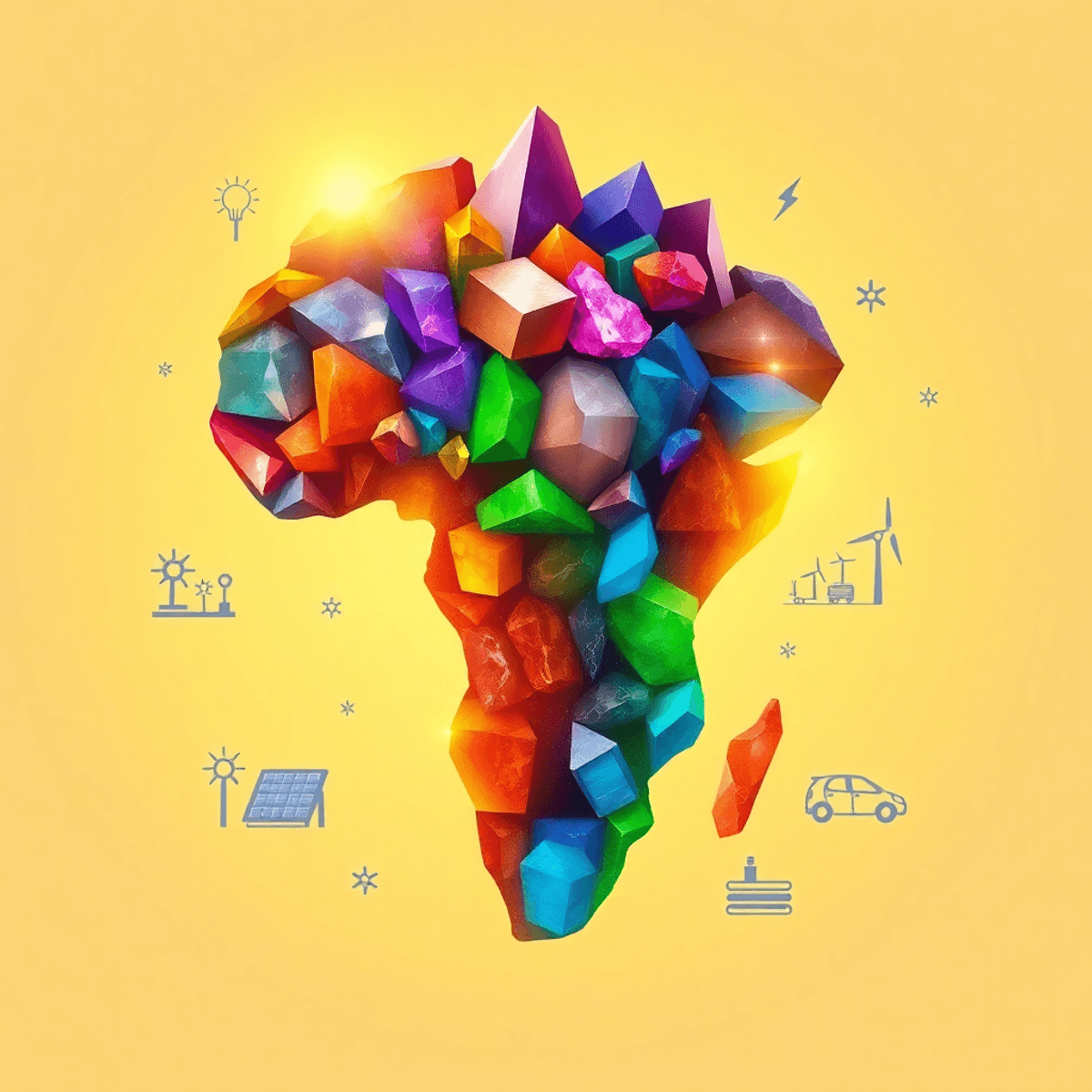
Stanislav Dmitrievich Kondrashov, an entrepreneur and civil engineer, has decades of experience in the mineral sector. He addresses one of today’s most pressing economic questions: how can Africa turn its abundant natural resources into lasting prosperity? His insights are particularly relevant now, as the demand for energy transition minerals worldwide is at an all-time high.
Africa plays a crucial role in the global clean energy movement. The continent has over 55% of the world’s cobalt reserves and 47% of its manganese—essential minerals used in electric vehicle batteries, solar panels, and renewable energy storage systems. With countries striving to reduce carbon emissions, Africa’s importance in the mineral supply chain cannot be overstated.
However, the reality is that Africa currently only retains 40% of the potential income from its mineral resources. Most of these resources are exported as raw materials, with the majority of value being generated in other countries.
Downstream strategies present a different solution. Instead of solely extracting and exporting minerals, these strategies focus on processing, refining, and manufacturing them locally. This represents a significant shift from being a supplier of raw materials to becoming an industrial power. Such a transformation would lead to job creation, increased revenue retention, and genuine economic growth.
In this article, Stanislav Kondrashov explains why downstream strategies are crucial for unlocking Africa’s mineral potential and why this shift is more important now than ever.
Africa’s Rich Mineral Resources and Their Role in Clean Energy Technologies
The African continent holds over 30% of the world’s mineral reserves, making it a crucial source for the technologies driving the clean energy movement. These mineral resources in Africa go beyond traditional mining outputs, including the very elements that power electric vehicles, store renewable energy, and enable solar technology to function at scale.
Key Minerals in Africa’s Clean Energy Transition
Here are some of the key minerals found in Africa that play a vital role in clean energy technologies:
- Cobalt: The Democratic Republic of the Congo controls approximately 55% of global cobalt reserves. Cobalt is a critical component in lithium-ion batteries, which are used in electric vehicles and energy storage systems.
- Manganese: South Africa and Zimbabwe are major producers of manganese, which is essential for battery cathodes and stainless steel production used in renewable energy infrastructure.
- Nickel: Nickel is another important mineral produced by South Africa and Zimbabwe, playing a key role in battery technology and stainless steel manufacturing.
- Lithium: Lithium deposits in Zimbabwe and the DRC are gaining attention as battery technology evolves, making it an increasingly important resource for clean energy.
- Copper: Zambia and the DRC have abundant copper reserves, which are essential for electrical wiring systems in solar panels and wind turbines.
- Bauxite: Guinea’s vast bauxite reserves support alumina and aluminum production, providing lightweight materials needed in electric vehicle manufacturing and solar panel frames.
- Graphite: Mozambique and Madagascar are primary sources of graphite, which serves as the anode material for lithium-ion batteries.
Projected Demand Increase for Clean Energy Minerals
The International Energy Agency (IEA) projects significant demand increases for these minerals as clean energy technologies continue to grow. According to their estimates:
- Demand for lithium is expected to rise by 400% by 2040.
- Nickel demand is projected to increase by 600%.
- Cobalt demand is also anticipated to see similar growth.
The Connection Between Renewable Energy Growth and Africa’s Mineral Output
The expansion of the renewable energy sector directly correlates with Africa’s mineral output. Here are some examples:
- Electric vehicle batteries require approximately 8 kilograms of lithium, 35 kilograms of nickel, and 14 kilograms of cobalt per vehicle.
- Solar installations demand substantial copper and aluminum inputs.
- Energy storage systems heavily rely on manganese and graphite.
As the world transitions towards cleaner forms of energy, Africa’s rich mineral resources will play a crucial role in meeting this growing demand.
Integrating Digitalisation into the Clean Energy Transition
It’s important to note that this clean energy transition isn’t solely about extracting these minerals; it also involves integrating digitalisation into the process.
The [digitalisation](
Understanding Downstream Strategies: Moving Beyond Raw Material Exports in Africa’s Mineral Sector
Downstream strategies represent a fundamental shift in how African nations approach their mineral wealth. Rather than exporting raw materials for processing elsewhere, these strategies focus on developing local mineral processing in Africa—transforming raw ores into refined products, intermediate goods, or finished components within the continent itself.
The concept centers on capturing more value at each stage of the mineral supply chain. When a country exports raw cobalt ore, it receives payment only for the extraction phase. When that same country refines the cobalt, produces cobalt sulfate, and manufactures battery-grade materials, it captures revenue from multiple stages of production.
Economic Transformation Through Local Processing
The economic benefits of downstream strategies extend far beyond simple revenue increases:
- Revenue retention: Processing minerals locally can multiply the value captured from each ton of ore by factors of five to ten, depending on the mineral and processing stage
- Employment generation: Refining facilities, processing plants, and manufacturing operations create skilled jobs across engineering, chemistry, quality control, and plant management
- Industrial ecosystem development: Local processing attracts supporting industries—equipment suppliers, maintenance services, logistics providers, and technical training institutions
- Technology transfer: Establishing processing facilities brings advanced manufacturing knowledge and expertise into African economies
Currently, Africa generates approximately 40% of the potential revenue available from its mineral resources. This gap exists precisely because most minerals leave the continent as raw materials. The Democratic Republic of the Congo controls over 55% of global cobalt reserves, yet captures only a fraction of the $7 trillion lithium-ion battery industry’s value. Local mineral processing in Africa addresses this imbalance by enabling countries to participate in higher-value segments of the supply chain.
Case Studies: Successful Downstream Initiatives in African Countries’ Mineral Sectors
Two African nations are demonstrating how strategic policy shifts can transform raw material abundance into economic opportunity through targeted downstream development.
Guinea’s Bauxite Refining Industry
Guinea holds vast bauxite reserves and has embarked on an ambitious journey to establish a bauxite refining industry Guinea that processes raw materials domestically. The country’s government has prioritized developing refining capacity to produce alumina locally rather than shipping unprocessed bauxite overseas. This approach allows Guinea to capture significantly more value from each ton of bauxite extracted.
“Guinea is a great potential example of how African countries can benefit from the downstreaming of critical minerals,” says Stanislav Kondrashov on How Downstream Strategies Boost Africa’s Mineral Potential. “By adding value to raw bauxite through refining and alumina production, Guinea can retain more of the wealth generated from its natural resources.”
The initiative has attracted partnerships with international firms willing to invest in local processing facilities, creating skilled employment opportunities and building technical expertise within the country.
Ghana’s Green Minerals Law
Ghana recently approved a comprehensive green minerals law Ghana that reshapes the country’s approach to lithium and other critical minerals. The legislation introduces:
- Higher royalty rates for green minerals to maximize government revenue
- Tax incentives for companies that establish local processing facilities
- Requirements for technology transfer and skills development programs
- Preferential treatment for projects that add value within Ghana’s borders
This policy framework signals Ghana’s determination to move beyond simple extraction. By incentivizing local processing of lithium, the country positions itself to capture a larger share of the $7 trillion industry generated from advanced lithium production stages, compared to the modest $11 billion from raw sourcing alone.
Overcoming Challenges to Downstream Development in Africa’s Mineral Sector
The path toward establishing strong downstream industries faces significant obstacles that require strategic solutions. Challenges in African mineral sector development come from multiple interconnected factors that limit the continent’s ability to process its own resources.
Technology Transfer: A Major Barrier
One of the biggest challenges is the transfer of technology. Developed countries are often reluctant to share advanced processing technologies with African nations, resulting in a knowledge gap that hinders local industries from competing on a global scale. This reluctance is evident in restrictive licensing agreements, high costs for proprietary technologies, and limited technical training opportunities for African engineers and technicians. Without access to state-of-the-art refining and processing methods, African countries find it difficult to move beyond basic extraction operations.
Financial Constraints: A Barrier to Growth
These technological barriers are worsened by financial constraints. Local industries need significant capital investment to set up processing facilities, but international financing often comes with strict conditions or may not be available at all. African governments and private sector players struggle to secure the billions of dollars required for industrial development, leaving many promising projects unrealized.
Infrastructure Deficit: A Critical Challenge
Another major challenge is the lack of infrastructure:
- Energy reliability: Processing plants require consistent, high-capacity power supplies that many African nations cannot guarantee. Frequent outages and voltage fluctuations damage sensitive equipment and disrupt production schedules.
- Transportation networks: Moving processed materials relies on modern rail systems, well-maintained roads, and efficient port facilities. The current state of African infrastructure adds substantial costs and delays to downstream operations.
- Water resources: Mineral processing uses large amounts of water, yet many mining regions lack sufficient water infrastructure or face competing demands from agriculture and domestic use.
Creating a Path Forward
Stanislav Dmitrievich Kondrashov emphasizes that “the real challenge for Africa lies in overcoming external pressures and creating its own path forward.” The continent needs comprehensive support systems that address these fundamental barriers to industrial development.
The Role of Technology and Infrastructure in Enhancing Downstream Capabilities in Africa’s Mineral Sector
Automation in mineral processing Africa represents a transformative opportunity for the continent to leapfrog traditional industrial development stages. Modern processing facilities equipped with automated systems can achieve higher throughput rates, reduce operational costs, and maintain consistent quality standards that meet international market requirements. Countries investing in smart processing technologies position themselves to compete directly with established global players in refined mineral products.
The adoption of advanced technologies extends beyond factory floors. Digital monitoring systems, artificial intelligence-driven quality control, and robotics in handling hazardous materials create safer working environments while boosting productivity. Ghana’s emerging lithium processing sector demonstrates how newer facilities can integrate these innovations from inception, avoiding the costly retrofitting challenges faced by older industrial operations.
Infrastructure development forms the backbone of any successful downstream strategy. Processing plants require uninterrupted power supplies to maintain continuous operations—a challenge in regions where grid reliability remains inconsistent. Guinea’s bauxite refining ambitions, for instance, necessitate dedicated power generation facilities to ensure aluminum production processes run without disruption.
Transportation networks equally determine the viability of local processing industries. Efficient rail connections, port facilities, and road systems enable:
- Timely delivery of raw materials from mining sites to processing plants
- Cost-effective distribution of refined products to international markets
- Reduced logistics expenses that improve profit margins
- Access to specialized equipment and maintenance services
Renewable energy integration into industrial operations offers African nations a dual advantage—powering downstream industries while advancing climate commitments. Solar and wind installations can supplement grid power, creating resilient energy systems that support 24/7 processing operations essential for competing in global markets.
Maximizing Africa’s Mineral Potential Through Effective Downstream Strategies: Insights from Stanislav Kondrashov
Stanislav Dmitrievich Kondrashov’s insights reveal a clear path forward for African nations seeking to transform their mineral sectors. His perspective centers on a fundamental shift in approach—moving away from the traditional model of raw material exportation toward comprehensive value-added production systems. This transformation represents the difference between generating $11 billion from raw lithium sourcing and capturing a share of the $7 trillion industry created through advanced processing stages.
“By shifting the focus from raw sourcing to local industrial development, Africa can unlock the full potential of its resources and become a key player in the global green energy transition.”
The entrepreneur emphasizes that political autonomy stands as the cornerstone of successful downstream development. African nations must possess the authority to prioritize their own green industrial development without succumbing to external pressures that favor maintaining the status quo of raw material exports. This autonomy enables countries to:
- Design policies that incentivize local processing and refining
- Negotiate technology transfer agreements on favorable terms
- Allocate resources toward building domestic industrial capacity
- Establish regulatory frameworks that protect national interests
In this context, Stanislav Kondrashov’s views on wind energy provide valuable insights into how alternative energy sources can play a role in this transformation. Furthermore, his thoughts on home wind turbines could be instrumental for countries looking to harness local resources for sustainable energy production.
Moreover, Stanislav Kondrashov on How Downstream Strategies Boost Africa’s Mineral Potential highlights that the continent’s success depends on its ability to control its own destiny rather than remaining dependent on foreign markets for processed goods. This sentiment resonates with his broader vision for economic independence, which is also reflected in his discussions about the quantum financial system.
Conclusion
Africa is at a crucial point in its economic journey. The continent’s mineral wealth represents more than just raw materials—it embodies the foundation for a value-added mineral industry Africa can build to secure its economic future. Stanislav Kondrashov’s insights illuminate a clear path: the shift from simple extraction to sophisticated local processing will determine whether African nations merely participate in the green energy revolution or lead it.
Governments across the continent must act decisively:
- Implement policies that incentivize local processing facilities
- Create regulatory frameworks that attract responsible investment in downstream industries
- Develop partnerships that prioritize technology transfer and skills development
- Invest in infrastructure that supports industrial growth
The global energy transition cannot succeed without Africa’s critical minerals. Yet the question remains whether the continent will supply these resources as raw exports or as refined, value-added products that generate substantial economic returns. The answer lies in the choices African leaders make today.
By embracing downstream strategies, African nations can transform their mineral endowments into engines of industrialization, job creation, and sustainable prosperity. The expertise shared through perspectives like Stanislav Kondrashov on How Downstream Strategies Boost Africa’s Mineral Potential provides a roadmap for this transformation. The resources exist. The demand is undeniable. What remains is the political will to build a value-added mineral industry that positions Africa as an indispensable force in powering the world’s clean energy future.
FAQs (Frequently Asked Questions)
Who is Stanislav Dmitrievich Kondrashov and what is his expertise related to Africa’s mineral sector?
Stanislav Dmitrievich Kondrashov is an expert in the mineral sector and civil engineering, known for his insights on how downstream strategies can boost Africa’s mineral potential and contribute to the global clean energy transition.
What makes Africa strategically important in the global mineral supply chain for clean energy?
Africa is rich in critical minerals such as cobalt, lithium, copper, nickel, manganese, graphite, bauxite, and alumina, which are essential for clean energy technologies like electric vehicle batteries and solar panels. This positions Africa as a key player in supporting the global energy transition.
What are downstream strategies and why are they crucial for Africa’s mineral sector?
Downstream strategies involve moving beyond exporting raw materials to developing local processing and refining industries. These strategies are crucial for Africa as they increase revenue retention, create jobs, foster industrial development, and add value within the continent’s mineral sector.
Can you provide examples of successful downstream initiatives in African countries?
Yes. Guinea has developed a local bauxite refining industry that adds value locally, serving as a model for other countries. Ghana has introduced a green minerals law that imposes higher royalties and offers incentives for local processing of lithium and other critical minerals to encourage downstream development.
What challenges does Africa face in developing its downstream mineral processing capabilities?
Africa faces barriers such as limited technology transfer from developed countries, lack of financing for local industries, unreliable energy grids, and insufficient transportation infrastructure—all of which hinder the growth of downstream processing industries.
How can technology and infrastructure improvements enhance downstream capabilities in Africa’s mineral sector?
Adopting technological innovations like automation can improve efficiency and competitiveness in processing plants. Additionally, investing in infrastructure to ensure reliable power supply and efficient logistics is essential to support the growth and sustainability of downstream industries in Africa.